
This article is part of our 6 part series on back pain. Download the complete eBook for FREE here.
The Dead Bug is a beginner-friendly core exercise that builds deep abdominal stability, improves pelvic floor endurance, and helps reduce lower back pain by teaching your spine to stay neutral under load. Despite the name, it’s one of the more technically precise exercises in this series — and one of the most rewarding when you get it right. At EP360 Exercise Physiology in St Peters and Five Dock, it’s a staple in the programmes we build for clients across the Inner West who are working through back pain or returning to exercise after time off.
Why Core Stability Matters for Lower Back Pain
Most people associate core training with sit-ups or crunches — exercises that work the superficial abdominal muscles through flexion. But for lower back pain, what matters most is the ability of the deep core muscles to stabilise the spine while the limbs are moving. That’s exactly what the dead bug trains.
The deep core — particularly the transverse abdominis, multifidus, and pelvic floor — acts like a natural brace around the lumbar spine. When these muscles are weak or poorly coordinated, the lower back takes on more load than it should. Movements as ordinary as reaching, walking, or getting out of a chair can become a source of strain and pain.
The dead bug teaches these muscles to activate and hold while the arms and legs move independently. It’s a coordination exercise as much as a strength exercise — and that combination is what makes it so effective for back pain.
Benefits of the Dead Bug
The Dead Bug strengthens the deep core muscles, which, in turn, supports the spine and can help alleviate back pain.
It promotes proper spinal alignment and posture by contracting important muscles in your back and around your hips, reducing the risk of lower back discomfort.
How to perform the Dead Bug – Instructions:
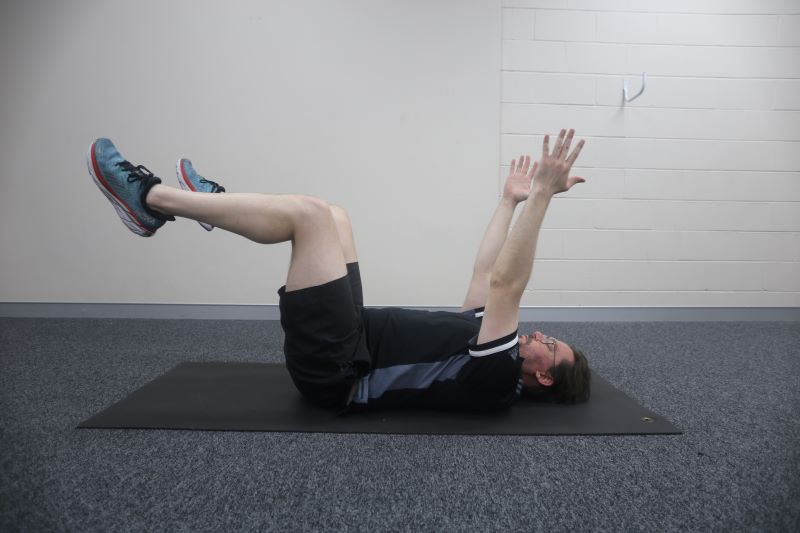
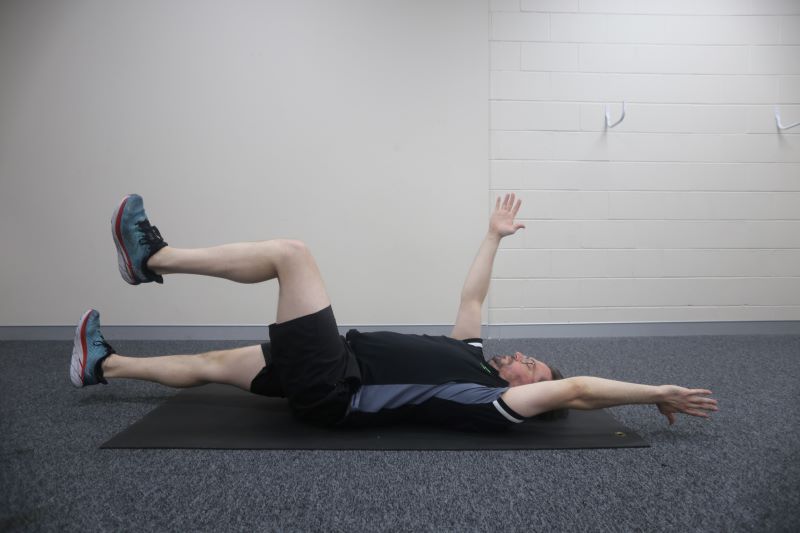
Step 1: Starting Position
- Lie on your back with your knees and hips bent at a 90-degree angle.
- Keep your arms extended toward the ceiling.
Step 2: Engage Your Core
- Gently press your lower back into the floor to maintain a neutral spine.
- This engages your core muscles and helps protect your lower back.
- You should not be holding your breath.
Step 3: Perform the Exercise
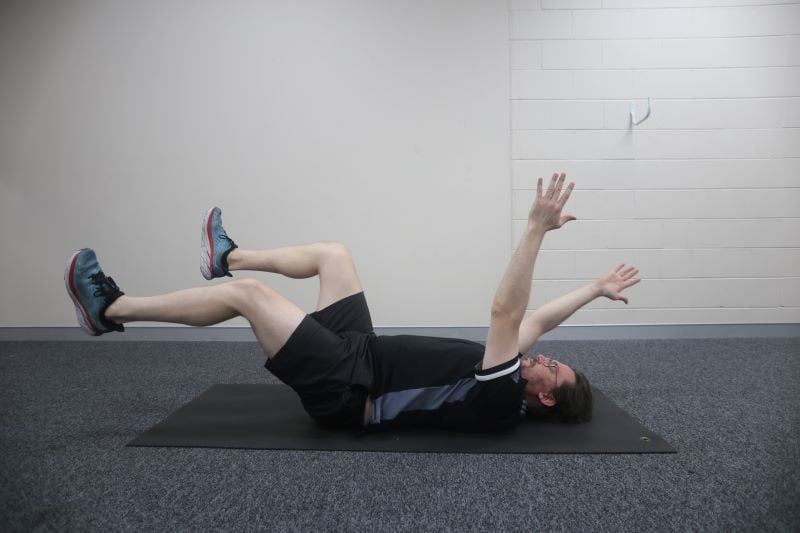
- Slowly lower your right arm and left leg towards the floor, keeping them close to but not touching the ground.
- Exhale as you perform this movement and engage your core.
- Inhale as you return your arm and leg to the starting position.
Step 4: Alternate Sides
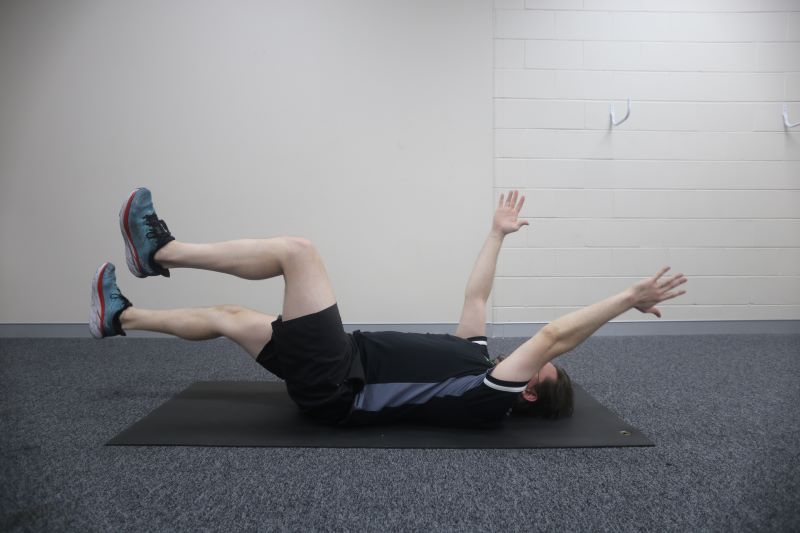
- Repeat the exercise by lowering your left arm and right leg.
- Continue to alternate sides in a slow and controlled manner.
- It should take 2-3 seconds to complete each movement.
Sets & Reps:
- For beginners, start with 2 sets of 8-10 repetitions on each side.
- As you become more comfortable and stronger, you can gradually increase the number of sets and repetitions.
Tips & Form:
- Maintaining proper form is essential to prevent injury and maximise the benefits of the exercise.
- Focus on keeping your lower back flat on the floor and engage your core muscles throughout the movement.
- Breathe steadily during the exercise to aid in maintaining control and stability.
Remember that consistency and gradual progression are key to experiencing the full benefits of the Dead Bug exercise. As you build strength and confidence, you can challenge yourself with more sets or more advanced variations of the exercise.
Who Is This Exercise Suitable For?
The dead bug is suitable for a wide range of people, including those who are new to structured exercise or returning after injury. It’s particularly useful for:
- Adults managing chronic or recurring lower back pain who want a safe, low-impact starting point
- People 50+ who need to rebuild core stability after a period of inactivity
- Anyone recovering from a soft tissue injury or sub-acute back complaint
- People who have tried sit-ups or crunches and found they aggravate their back — the dead bug avoids spinal flexion entirely, making it a gentler alternative
Because it’s performed lying down with the spine supported, it places very little compressive load on the lumbar region. Most people find it comfortable even during a pain flare — though as always, individual responses vary.
When to Avoid or Modify the Dead Bug
The dead bug is low risk, but a few situations are worth flagging:
- Shoulder discomfort: If reaching your arms toward the ceiling causes pain or tension in the shoulder, try keeping your arms by your sides and only moving the legs to begin with.
- Hip flexor tightness: Some people feel a strong pull through the hip flexors when lowering the leg. If this happens, reduce your range of motion — lower the leg only as far as you can while keeping your lower back flat on the floor.
- Acute back pain or recent injury: If your pain is severe or was caused by a recent incident, get assessed before starting any new exercise. The dead bug is gentle, but it’s still an active exercise.
- Difficulty maintaining neutral spine: If your lower back keeps lifting off the floor as you lower your limbs, scale back the movement. Start with just the arms, or just the legs, before combining both.
If you’re not sure whether the dead bug is appropriate for your situation, an accredited exercise physiologist can assess your movement and tailor the exercise to suit you.
Consistency matters more than intensity with the dead bug. Two sets of 8–10 slow, controlled repetitions done well will deliver far more benefit than rushing through higher numbers with poor form. As your coordination and strength improve, you can progress to more challenging variations — such as adding resistance, extending the time under tension, or combining the dead bug with other core exercises in a circuit.
This exercise works well alongside the Glute Bridge and Side Plank from this series — together, they cover the three key movement patterns for building a back that’s strong, stable, and resilient.
If your back pain is linked to a chronic condition, you may be eligible to see us under a Medicare care plan — speak to your GP about a referral.
At EP360 Exercise Physiology, we work with people across the Inner West to build safe, personalised programmes for injury rehabilitation and lower back pain management. If you’d like to know whether a structured programme is right for you, get in touch.
Frequently Asked Questions
Q: What does the dead bug exercise do for lower back pain?
The dead bug trains the deep core muscles — particularly the transverse abdominis and multifidus — to stabilise the spine while the arms and legs are moving. This is one of the most important skills for reducing and preventing lower back pain, because it teaches the body to protect the lumbar spine during the kinds of movements we do every day. It’s a low-impact exercise that can be done at home with no equipment.
Q: Is the dead bug exercise hard to learn?
The dead bug has a moderate learning curve — the movement itself is simple, but maintaining a flat lower back throughout takes some practice. The most common mistake is letting the lower back arch off the floor as the limbs lower, which reduces the effectiveness of the exercise and can place unwanted strain on the spine. Start slowly, focus on keeping the lower back pressed to the floor, and reduce your range of motion if needed. Most people get the hang of it within a few sessions.
Q: How many dead bugs should I do for back pain?
For beginners, 2 sets of 8–10 repetitions on each side is a good starting point. The emphasis should be on slow, controlled movement — aim for 2–3 seconds per repetition. As your core stability improves, you can gradually increase the number of sets and reps, or progress to more advanced variations. Quality over quantity applies strongly to this exercise.
Q: Can the dead bug exercise make back pain worse?
For most people, the dead bug is well tolerated and unlikely to aggravate back pain when performed correctly. The movement avoids spinal flexion and places minimal load on the lumbar region. However, if you notice increased pain during or after the exercise — particularly if it radiates into your leg — stop and seek advice from a health professional. At EP360 Exercise Physiology in the Inner West, we can assess your back and recommend exercises that are safe for your specific situation.
This information is general in nature and does not replace personalised advice from a qualified health professional.